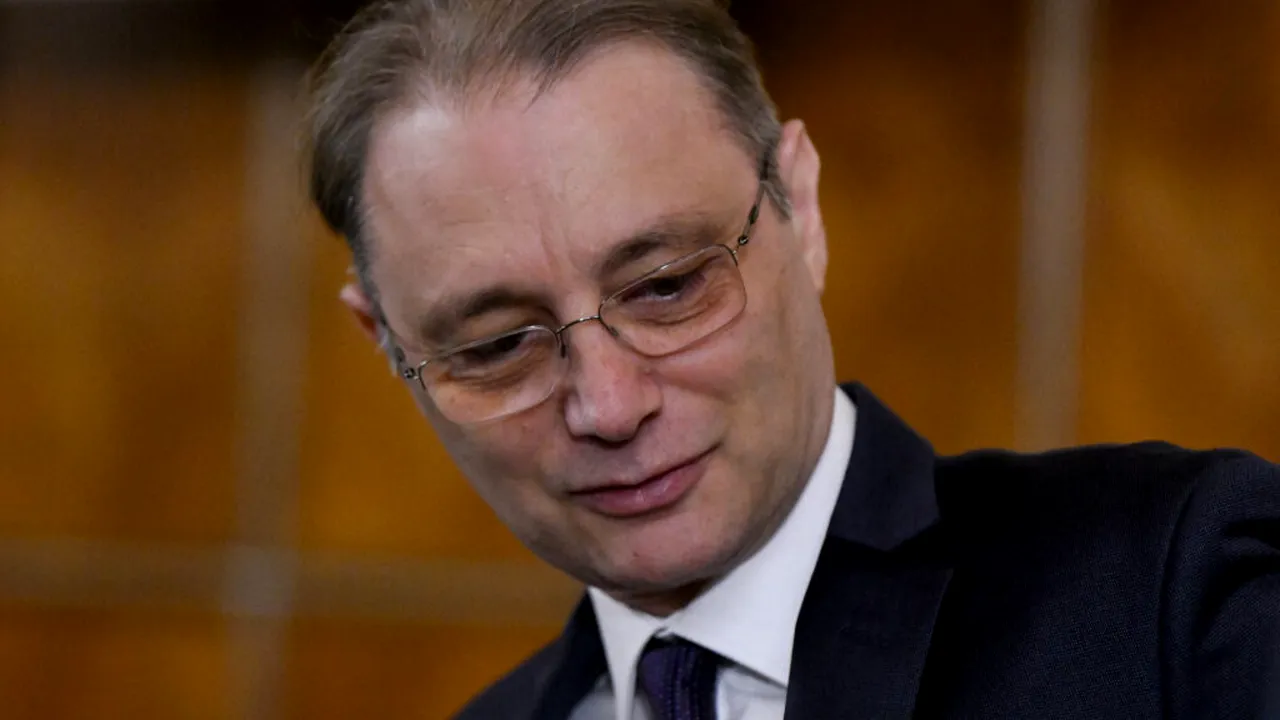


These remarks were made at the headquarters of the National Bank of Romania (BNR) during the launch of the report „Assessing Romania’s Competitiveness: A 2027–2035 Strategic Outlook,” produced under the coordination of former Italian Prime Minister Enrico Letta.
Luca Niculescu highlighted Romania’s economic progress over the last 25 years, but warned that the current model of economic growth has „run its course.”
„In 25 years, Romania has risen from 26% to 78% of the European average for GDP per capita—a faster rate of convergence than any other state that has joined the European Union since 2004. As Enrico writes, this is one of the best illustrations of the transformative power of the European Union. However, the model that brought us here has run its course,” the Prime Minister stated.
The Prime Minister also pointed to the discrepancies between Romania’s performance in certain areas and its standing in international competitiveness rankings. „In terms of export complexity, we rank 29th out of 130 economies. Regarding competitiveness, we are 61st out of 70—placing us second to last in the European Union. In short, while we are capable of producing sophisticated goods, we sometimes manage to make simple things overly complicated,” stated Niculescu.
Niculescu also highlighted issues concerning the digitalization of public administration, despite Romania’s well-developed telecommunications infrastructure.
„96% of our households have access to fiber optics—we rank first in Europe. Yet, when it comes to digital public services, we rank last,” the Prime Minister noted.
The Prime Minister also drew attention to the political instability in Romania.
„The report also points to something that, in a way, affects me personally at this moment: 11 prime ministers in 10 years. We have a problem with stability and with committing to decisions that transcend political cycles and crises,” Niculescu remarked.
Luca Niculescu mentioned that some of the measures recommended in the report are already included in the government’s agenda—such as simplifying public administration, reducing the budget deficit to below 3% of GDP by 2031, and providing targeted support in the energy sector.
The Prime Minister announced that he is in discussions to establish a committee tasked with developing a competitiveness strategy for Romania. „That is why I am holding preliminary discussions regarding a committee for Romania’s competitiveness, which would bring together independent economists alongside the Fiscal Council, the National Bank, and the Presidential Administration. It will have a precise mandate: an initial version of the strategy within six months, the final version within twelve months, and the indicators from today’s report will serve as the dashboard,” the Prime Minister explained.
Niculescu emphasized the need for a political and social consensus to ensure that the strategy is also implemented by future governments.
„A committee alone is not enough; the strategy must endure beyond the current administration. That is why its targets will be incorporated into the partnership plan with the European Union for 2028–2034—a framework where, as you know, funding is contingent upon meeting specific milestones. For this reason, I am proposing a ‘pact for competitiveness’ to political parties, employers’ associations, and trade unions. We achieved such a consensus for our accession to the OECD, and we can do so again,” stated Niculescu.
The Prime Minister expressed his support for Romania’s accession to the Eurozone, noting that the report proposes 2035 as the target year for adopting the single European currency.
„The President of Romania has stated on several occasions that this is an objective he supports. Governor Mugur Isărescu has also remarked that we must once again take concrete steps. I join you in this endeavor. What the Government can do is maintain the fiscal trajectory agreed upon with the European Commission through 2031,” affirmed Niculescu. He stated that adhering to the fiscal trajectory could enable Romania to once again meet the criteria for joining the euro area by the beginning of the next decade.
“If we do this, we can expect to meet the euro area accession criteria again by the start of the next decade. Furthermore, I will support the Presidential Administration or the National Bank should you decide to lay the groundwork for a new roadmap,” the Prime Minister added.